Boolean algebra solver
Simplify a Boolean expression the way ISC Computer Science asks for it: the working law by law, the truth table, the K-map with its groups, the minimal SOP and POS forms, and the logic circuit - also with NAND or NOR gates only. Free, with nothing to sign up for.
How to use it
- 1Type a Boolean expression such as A'B + AB', or give minterms like F(A,B,C) = Σ(1,3,5).
- 2Press Solve, or tap an example to see how it is written.
- 3Read the working: the laws used, the truth table, the K-map groups, the minimal SOP and POS, and the circuits.
A'B'C + A'BC + AB'C + ABC' + ABC
This is the kind of answer you get. Put these values in the boxes or type your own.
Answer
- Minimal SOP
- F = AB + C
- Minimal POS
- F = (A + C)(B + C)
- Minterms
- F(A, B, C) = Σ(1, 3, 5, 6, 7)
- Maxterms
- F(A, B, C) = π(0, 2, 4)
Read as A'B'C + A'BC + AB'C + ABC' + ABC. It is a contingency (sometimes 1, sometimes 0).
Steps, law by law
F = A'B'C + A'BC + AB'C + ABC' + ABC
- = A'C(B' + B) + AB'C + ABC' + ABCDistributive law AB + AB' = A(B + B')
- = A'.C.1 + AB'C + ABC' + ABCComplement law A + A' = 1
- = A'C + AB'C + ABC' + ABCIdentity law A.1 = A
- = A'C + AC(B' + B) + ABC'Distributive law AB + AB' = A(B + B')
- = A'C + A.C.1 + ABC'Complement law A + A' = 1
- = A'C + AC + ABC'Identity law A.1 = A
- = C(A' + A) + ABC'Distributive law AB + AB' = A(B + B')
- = C.1 + ABC'Complement law A + A' = 1
- = C + ABC'Identity law A.1 = A
- = C + ABAbsorption law A + A'B = A + B
Convert to POS, step by step
Work out F' as a sum of products, then F = (F')' by De Morgan's law.
- F' = (C + AB)'Complement F' = (F)'
- F' = C'(AB)'De Morgan's law (A + B)' = A'B'
- F' = C'(A' + B')De Morgan's law (AB)' = A' + B'
- F' = C'A' + C'B'Distributive law A(B + C) = AB + AC
- F = (C'A' + C'B')'Complement again F = (F')'
- F = (C'A')'(C'B')'De Morgan's law (A + B)' = A'B'
- F = ((C')' + (A')')(C'B')'De Morgan's law (AB)' = A' + B'
- F = (C + (A')')(C'B')'Involution law (A')' = A
- F = (C + A)(C'B')'Involution law (A')' = A
- F = (C + A)((C')' + (B')')De Morgan's law (AB)' = A' + B'
- F = (C + A)(C + (B')')Involution law (A')' = A
- F = (C + A)(C + B)Involution law (A')' = A
Truth table
| A | B | C | AB'C | A'B'C + A'BC + AB'C | AB | C' | ABC' | A'B'C + A'BC + AB'C + ABC' | ABC | A'B'C + A'BC + AB'C + ABC' + ABC |
|---|---|---|---|---|---|---|---|---|---|---|
| 0 | 0 | 0 | 0 | 0 | 0 | 1 | 0 | 0 | 0 | 0 |
| 0 | 0 | 1 | 0 | 1 | 0 | 0 | 0 | 1 | 0 | 1 |
| 0 | 1 | 0 | 0 | 0 | 0 | 1 | 0 | 0 | 0 | 0 |
| 0 | 1 | 1 | 0 | 1 | 0 | 0 | 0 | 1 | 0 | 1 |
| 1 | 0 | 0 | 0 | 0 | 0 | 1 | 0 | 0 | 0 | 0 |
| 1 | 0 | 1 | 1 | 1 | 0 | 0 | 0 | 1 | 0 | 1 |
| 1 | 1 | 0 | 0 | 0 | 1 | 1 | 1 | 1 | 0 | 1 |
| 1 | 1 | 1 | 0 | 0 | 1 | 0 | 0 | 0 | 1 | 1 |
K-map
- AB pair: cells 6, 7
- C quad: cells 1, 3, 5, 7
- (A + C) pair: cells 0, 2
- (B + C) pair: cells 0, 4
Canonical forms
SOP (sum of minterms)
F = A'B'C + A'BC + AB'C + ABC' + ABC
POS (product of maxterms)
F = (A + B + C)(A + B' + C)(A' + B + C)
Logic circuit
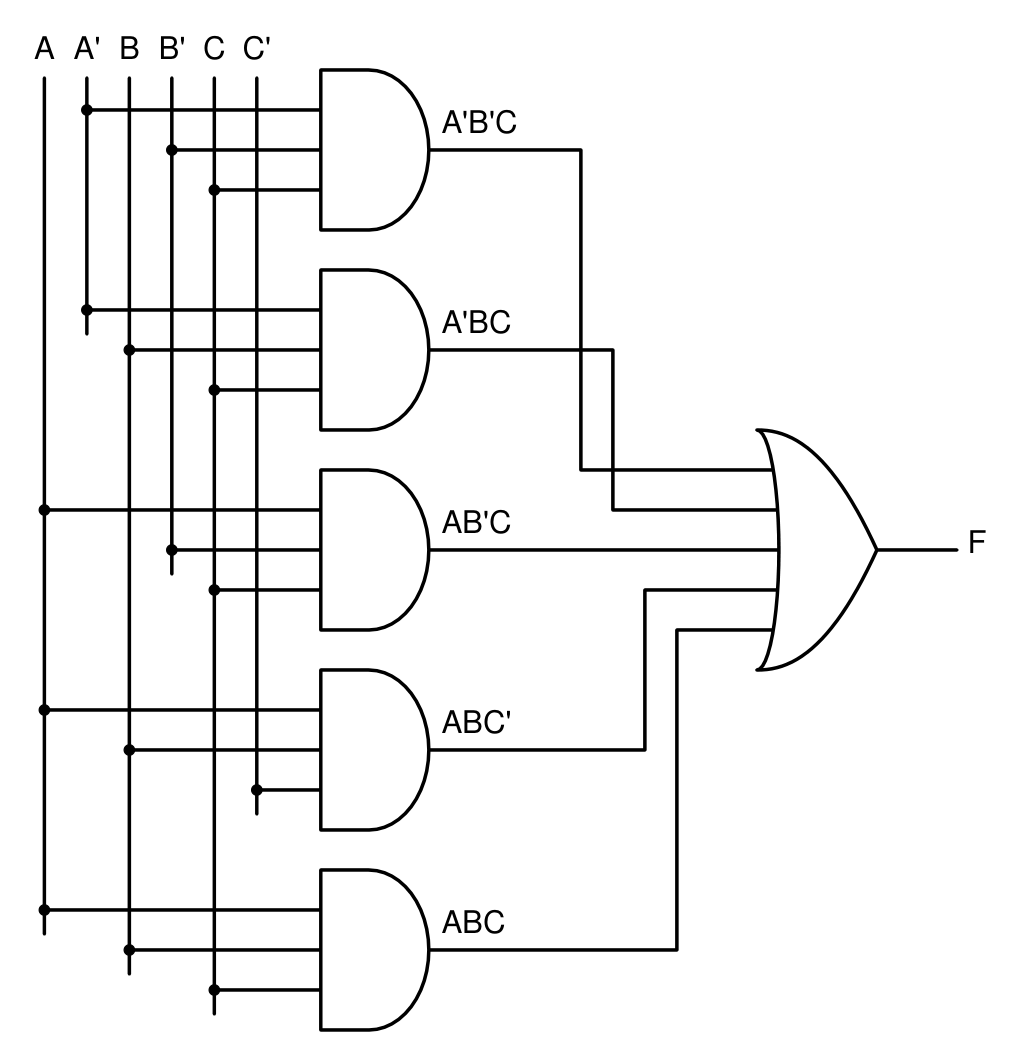
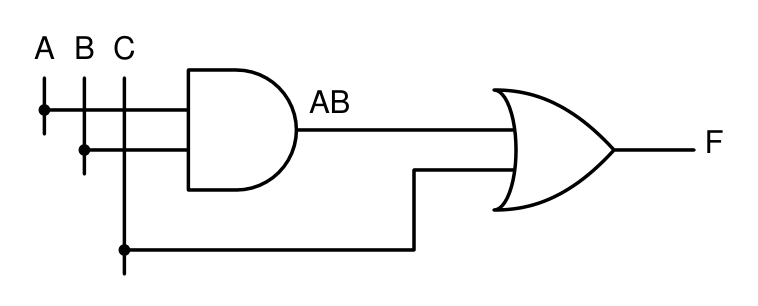
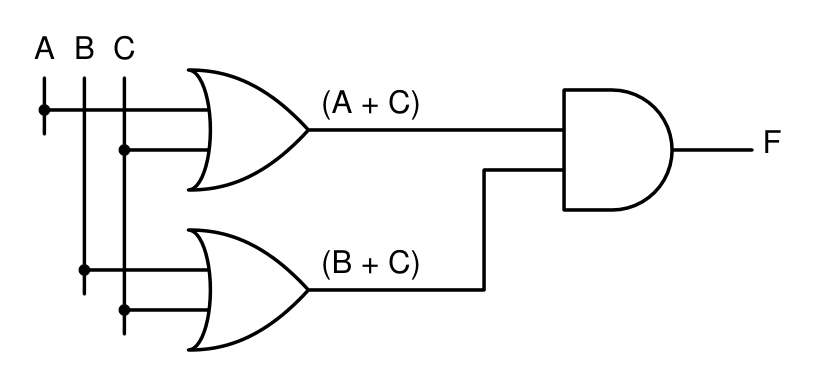
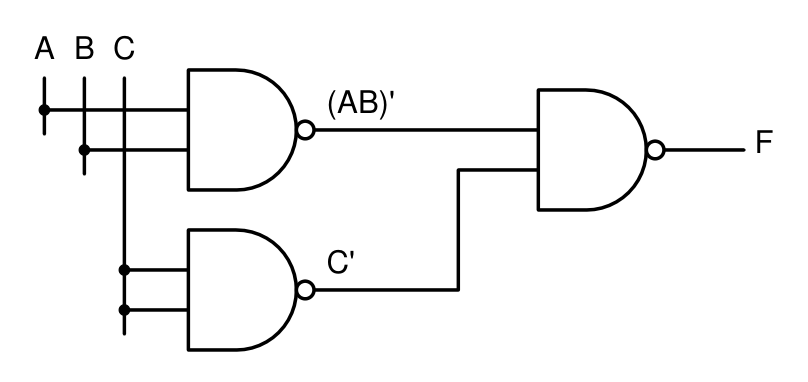
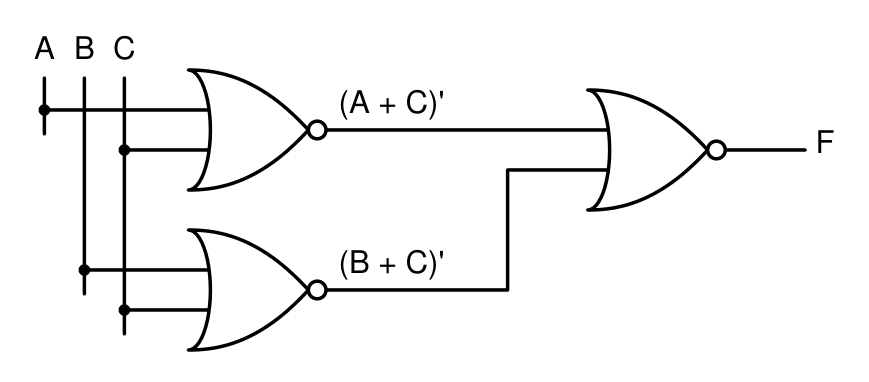
About the Boolean algebra solver
What it does
Boolean algebra questions in ISC Computer Science ask you to simplify an expression, prove that two expressions are equal, draw a truth table, group a K-map or draw the logic circuit. This solver does all of them from one input and names the law used at every step, so you can compare it with your own working.
How the answer is worked
- The expression is read and its truth table is built (up to 6 variables).
- It is simplified one step at a time with the Boolean laws: commutative, distributive, absorption, De Morgan’s and the rest, each named.
- The K-map is filled in and the biggest groups of 1s (pairs, quads, octets) give the minimal SOP; groups of 0s give the minimal POS.
- The circuit is drawn with AND, OR and NOT gates, then with NAND gates only and NOR gates only.
How to write the input
NOT is A' (or ~A), AND is AB or A.B, OR is +, XOR is ⊕ (the words AND, OR, NOT, XOR, NAND and NOR work too). For a function given by its minterms write F(A,B,C) = Σ(1,3,5) + d(7), or use π for maxterms. The buttons under the box type the symbols for you.
Common questions
What is the difference between SOP and POS?
SOP (sum of products) is an OR of AND terms, read from the 1s of the truth table or K-map. POS (product of sums) is an AND of OR terms, read from the 0s. Both describe the same function.
How do I check that two expressions are equal?
Type one in the first box, open “Check that it equals another expression” and type the second. The solver compares them and tells you whether they are equal.
Why do NAND and NOR gates matter?
Each is a universal gate: any circuit can be built from NAND gates alone, or from NOR gates alone. Questions often ask for exactly that, so the solver draws both versions.
What does d(…) mean in F(A,B,C,D) = Σ(…) + d(…)?
The numbers in d(…) are don’t-care conditions: cells you may treat as 1 or as 0, whichever makes the K-map groups bigger.
Practise on real ISC questions
- Given the Boolean function $F(A,B,C,D) = \Sigma(2, 3, 6, 7, 8, 10, 12, 14, 15)$. Reduce the above expression…2023
- Find the dual for the Boolean equation: $AB' + BC' + 1 = 1$.2020 Specimen
- If Sujata is in the merit list, then she is a topper ($Y \Rightarrow X$). Study the given propositions and…2025 Improvement
- The complement of the Boolean expression $(P + Q') \cdot (R' + P)$ is:2025 Improvement
- The Quad group in a Karnaugh’s map eliminates:2022 Specimen
- Using the truth table, state whether the following proposition is a tautology, contingency or a…2018
- The owner of a company pays bonus to his salesmen as per the criteria given below: • If the salesman works…2019
- If $(\sim p \Rightarrow \sim q)$ then its contra positive will be:2023
- Converse2019
- Post pandemic, to encourage the tourism industry in India, the Ministry of Tourism started a policy in which…2025 Practice
More Computer Science tools
- Infix to postfix converterInfix to postfix or prefix with the stack table, and postfix evaluation step by step.
- Binary tree and BST toolBuild a binary search tree, rebuild a tree from two traversals, and get every traversal and fact.
- Stack and queue simulatorRun push, pop, insert and delete on a stack, queue, circular queue or dequeue, and watch the pointers move.
- Recursion visualiserWatch factorial, Fibonacci, power, GCD and sum of digits run: the calls, the call stack and the returns.
- Tower of Hanoi visualiserWatch the discs move between the pegs while the recursive calls and the call stack build up.
- Binary search tree visualiserWatch values being inserted into a binary search tree, searched for, and walked inorder, preorder and postorder.
- Binary tree traversal visualiserClick a binary tree together and watch preorder, inorder and postorder walk it, with the recursive calls on the call stack.
- Stack and queue visualiserWatch push, pop, insert and delete move top, front and rear along the array, with overflow and underflow.
- Linked list visualiserWatch nodes being added, deleted, searched, traversed and reversed, with start, p, prev and curr moving along the arrows.
- 2D array visualiserWatch row-wise, column-wise, diagonal, boundary and spiral walks number the cells of a 2D array in the order they print.
- Sorting visualiserWatch bubble, selection and insertion sort compare, swap and shift your own list, step by step.
- Linear and binary search visualiserWatch a linear or binary search look for a value in your list, and count the comparisons.